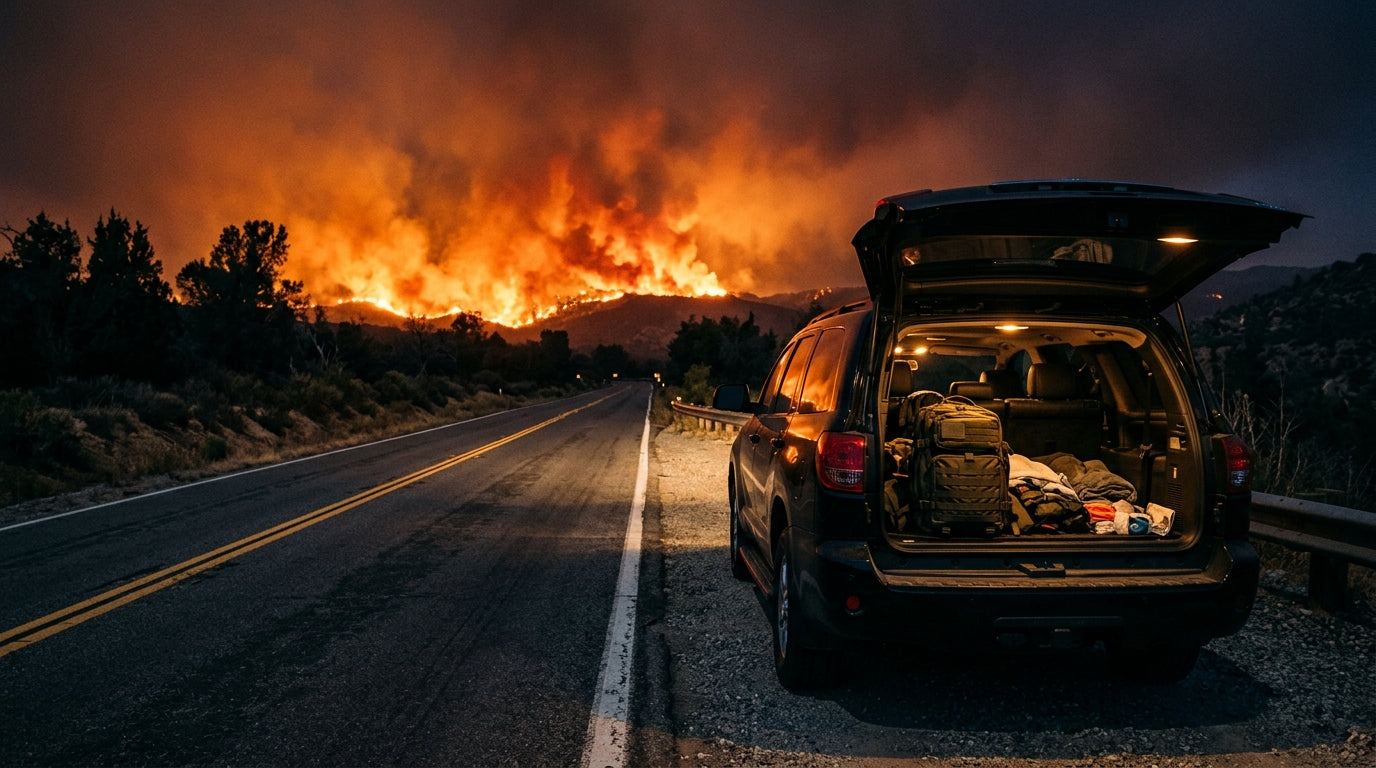
72 Hours
A Survival Story
2:14 AM
The sound didn't ease him awake. It detonated.
Marcus sat up in the dark before his eyes were open, his heart already running hard, the way it does when your body understands danger before your mind does. The alarm was coming from his phone on the nightstand — not his regular alarm, not a notification. The emergency alert sound. The one you'd never mistake for anything else.
His wife, Dana, had her hand on his arm before the second pulse. They'd been married eleven years. She'd heard the same sound.
He grabbed the phone.
WILDFIRE EMERGENCY — MANDATORY EVACUATION — ZONE 4 — LEAVE IMMEDIATELY — DO NOT DELAY
Zone 4. Their zone.
Marcus was out of bed and moving before the alert finished displaying. He'd thought about this moment more times than he could count — lying awake on still nights, reading accounts of people who'd lost everything because they waited too long, because they didn't believe it would really happen, because they spent twenty minutes trying to pack and found themselves trapped. He'd told Dana: when the real alert comes, we won't have time to think. We just move.
She'd believed him the third time he said it. Maybe the fourth.
Tonight she believed him completely.
Nine Minutes
Dana went for the kids. Marcus went for the closet.
The bag was on the top shelf, right side, where it had lived for eight months. He'd put it there the week after he'd finished building it — testing it, adjusting it, repacking it until he was satisfied — and then he'd set it there and told himself: don't touch it unless you need it. He'd checked it twice since. Inventory. Nothing missing, nothing expired.
He grabbed it by the top handle and felt the familiar weight settle in his hand. Forty-two pounds, fully loaded. He'd carried it on two trail runs just to know what that felt like under stress.
From the bedroom he heard his son, Jake, age seven, starting to cry. Not the scared kind — the disoriented kind. The middle-of-the-night-what-is-happening kind. Dana's voice was low and steady: we're going on a trip, buddy, right now, get your shoes.
Marcus grabbed the fireproof document folder from the top drawer of his desk — passports, birth certificates, insurance cards, a USB drive with the home photos backed up — and moved toward the front door.
Dana came down the hall with Jake on her hip and their daughter, Lily, four years old, walking fast beside her in a sleep shirt and rain boots she'd apparently chosen herself.
Their dog, a seven-year-old lab named Ruckus, was already at the door.
They were in the car in nine minutes.
As Marcus backed out of the driveway, he looked up. The horizon to the east — where the fire was — was orange. Not a sunrise orange. A wrong orange. A color that didn't belong in the sky at 2:23 in the morning.
He put the car in drive and didn't look back.
The Road North
The evacuation route was Highway 18 north, which Marcus knew from memory because he'd driven it twice specifically to know it. Both kids were crying now — Jake from fear, Lily because Jake was crying and she'd decided that seemed like the right response. Ruckus was in the back seat between them, panting, which was somehow steadying.
Dana had her phone out, trying to get local news. Cell service was already degrading — too many people on the network at once. She got fragments. Fire moving fast. Wind shifting. Two structures confirmed lost on Ridgeline Road.
Ridgeline Road was three streets from theirs.
"Don't tell me things like that while I'm driving," Marcus said.
"Then don't ask me to read updates while you're driving."
He almost laughed. Eleven years.
They drove through a convoy of headlights heading north — every lane moving, nobody panicking, that strange civic calm that descends when everyone's in the same situation and there's nothing to do but move forward. Marcus kept his speed steady. Left enough following distance. Watched for brake lights.
By the time they reached the shelter — an old high school gymnasium in Ridgecrest, forty-one miles from their house — it was nearly 4 AM.
The Gymnasium
There were maybe three hundred people inside when they arrived. By 6 AM there were closer to five hundred. Cots in rows, the kind with the thin foam pads that feel like sleeping on a yoga mat on a hard floor. Fluorescent lights that never turned off. A folding table near the entrance with volunteers handing out water bottles and granola bars — one each, while supplies lasted.
Marcus found a corner section of the floor and set up their space. He laid the bag down and unzipped it methodically, taking stock.
Within the first hour he used four things.
The first was the first aid kit. Jake had scraped his arm against the car door frame in the rush — not serious, but bleeding, and the kid was already shaken. Marcus cleaned it, applied antiseptic, and had him bandaged and calm in under four minutes. A volunteer nearby asked if he had extra supplies and Marcus gave her two additional bandages and a packet of antiseptic wipes without hesitating. He had enough.
The second was the flashlight. The gymnasium's backup lighting was dim and yellowed, and Lily — who had been holding herself together with four-year-old determination since the evacuation began — broke down completely when they moved toward the darker corner of the gym. Marcus clicked on the flashlight and handed it to her. She spent the next two hours pointing it at things and announcing what she saw. Floor. Bag. Daddy's shoe. Ruckus. It settled her completely. Sometimes the most important piece of survival gear is the one that keeps a child calm.
The third was the emergency mylar blanket. The gymnasium's AC was running hard — nobody had thought to turn it off and the night outside was still warm, but inside was cold and they'd left without jackets. He wrapped it around Dana and both kids. Lily immediately decided it was a cape and refused to take it off for the rest of the night.
The fourth was the food.
The volunteer table ran out of granola bars at around 5:30 AM. A murmur went through the gymnasium — not panic, but the particular anxiety that moves through a room when people realize the infrastructure supporting them has a limit. Jake looked up at Marcus with that expression kids have that they haven't learned to hide yet, the one that asks: are we okay?
Marcus opened the food section of the bag and handed him an energy bar.
Jake took a bite, chewed, made a face. "It's kind of weird."
"It's survival food. It's supposed to be weird."
"Does it actually keep you alive?"
"That's exactly what it does."
Jake took another bite. "Okay," he said. And the question in his eyes — are we okay — went away.
Hour Eighteen
By late morning, Marcus had a clearer picture of the gymnasium's social ecosystem. There were three kinds of people.
The first kind had nothing. They'd left in the same nine-minute window Marcus had, but with no preparation — no bag, no plan, no documents. A man named Gerald, mid-sixties, who'd lived in the same house for thirty-two years, was sitting on a cot near the entrance with a phone at 4% battery, no charger, and no medication for the blood pressure condition he'd been managing for a decade. His pills were on his bathroom counter three miles inside the evacuation zone.
The second kind had half a plan. They'd grabbed things — phone chargers, a change of clothes, some snacks — but not a system. Not redundancy. Not the items you don't think of until you need them.
The third kind — a small minority — had bags. They were easy to spot. They moved with a different quality of calm. They weren't relaxed exactly, but they weren't frantic either. They were managing. One woman, maybe forty, had a full family setup in a corner that looked almost organized — kids eating, dog sleeping, herself reading a paperback while her husband talked quietly on a handheld radio.
Marcus walked over and introduced himself.
Her name was Patricia. Her husband was a former EMT who'd been building their family prep kit for six years. They'd evacuated twice before — once for a hurricane, once for a chemical plant incident near their previous home in Louisiana.
"Third time," she said, not without humor.
"Does it get easier?"
She thought about it. "The first time you're terrified. The second time you're anxious. The third time you're just... moving through it. You trust the system."
Trust the system. Marcus thought about that for a long time.
Hour Thirty-Six
The second night was harder than the first.
The first night had the adrenaline of the event itself — the urgency, the motion, the sense of doing something. The second night was just waiting. The fire was still burning. The evacuation order was still in effect. There was nothing to do but sit in a gymnasium that smelled like three hundred people and industrial cleaning solution and try to sleep on a cot that was slightly too short.
Jake woke up at 2 AM asking for water. Marcus handed him the filtered water bottle from the bag — he'd refilled it twice from the bathroom tap, running it through the filter each time — and sat with him until he went back to sleep.
In the darkness Marcus thought about the house. He'd rebuilt the back deck two summers ago. Dana's garden — the one she'd spent three years developing, with the raised beds and the drip system she'd engineered herself. Jake's room, which had hand-painted murals on the wall that Marcus had done badly but with complete commitment when Jake was two years old. Lily's stuffed rabbit collection, which she treated with a seriousness that suggested she believed they were actually alive.
He thought: it might all be gone.
And then he thought: we're not gone. Everyone in this row of cots is alive.
He'd read something once — he couldn't remember where — about how the purpose of preparedness isn't to prevent bad things from happening. Bad things happen regardless. The purpose is to make sure that when they happen, the bad thing is the bad thing — not the bad thing plus you weren't ready.
Their house might be ash. But they were fed, hydrated, medicated, warm, and together. The bag had done exactly what it was built to do.
He fell asleep around 3 AM.
Hour Fifty-Eight
Gerald — the man with the blood pressure pills on his bathroom counter — had a bad morning on day two. He wasn't in crisis, but he was pale and shaky, and the shelter's volunteer medical team was stretched thin. Marcus found out his medication, cross-referenced it with what he'd read during the year he'd spent building his kit, and confirmed that his emergency supply had nothing that would help directly. But he had electrolyte packets and a blood pressure cuff he'd added to the kit on a whim after his own father's health scare the previous year.
He sat with Gerald for an hour. Monitored his numbers. Kept him calm and hydrated. Waited with him until one of the medical volunteers had time to come over and get him properly assessed.
Gerald shook Marcus's hand when the volunteer left.
"You some kind of doctor?" he asked.
"Manufacturing operations. Intel, twenty-three years."
Gerald looked at him for a moment. "Well," he said. "Thank you."
It was a small thing. In the context of a major wildfire evacuation affecting thousands of people, it was objectively small. But Marcus thought about it later and decided it was also the whole point. Preparedness isn't just about protecting yourself. When you're resourced, you have something left over. When you have something left over, you can help the Gerald next to you.
The unprepared can barely help themselves. The prepared can help their neighbors.
Hour Seventy-Two
The all-clear came at 11:47 AM on the third day.
Zone 4 was reopened. The fire had been pushed back by a wind shift overnight — the same wind that had driven it toward their neighborhood had reversed and starved it of the fuel it needed. Not every neighborhood had been so lucky. Zone 6 was gone. Thirty-four homes, a small church, a veterinary clinic that had been serving the area for forty years.
The gymnasium erupted in something that wasn't quite cheering — it was more complicated than that, given what Zone 6 residents were facing — but there was movement, tears, phone calls, the specific chaos of hundreds of people suddenly having somewhere to go.
Marcus packed the bag methodically. First aid supplies depleted by about a third. Food down by half. Water filter still fully functional. Everything else intact. He made a mental note of what needed restocking.
He found Patricia and her husband on the way out. They shook hands.
"Good luck," she said.
"You too. Third time."
She smiled. "Hopefully the last."
They drove home through streets covered in a fine gray ash that had drifted like snow. The house was standing. Dana made a sound he'd never heard from her before when she saw it — not words, just breath released from a place deep enough that it had been held there for three days. The garden was fine. The deck was fine. The murals in Jake's room were fine.
Lily went straight to her stuffed rabbits and conducted what appeared to be a roll call.
Dana stood in the kitchen for a long time. Then she turned around.
"I want to get a second bag," she said. "For the car."
Marcus nodded. "Already on the list."
What the Bag Actually Is
There's a version of this story where Marcus didn't have the bag. Where he grabbed a gym duffel in nine minutes and threw in a phone charger, a hoodie, and half a box of granola bars. Where Jake's arm bled longer than it needed to. Where Lily cried in the dark for an hour and nobody had anything to give her. Where the food ran out when the volunteer table ran out. Where Gerald didn't have anyone sitting with him at hour fifty-eight.
There's also a version where the fire went the other way and burned everything Marcus owned, and the bag was still the thing that got four people and a dog through seventy-two hours of displacement with their health and their calm more or less intact.
In neither version does the bag prevent the emergency. Emergencies are going to happen. That's not a pessimistic statement — it's just the nature of living in a world with weather, infrastructure, geology, and human error.
What the bag does is simple: it makes sure that when the emergency comes, you're not dealing with the emergency and the consequences of being unprepared at the same time.
One crisis is survivable. Two crises at once is where people break.
The bag removes the second crisis before it starts.
Complete 72-Hour Fully Loaded Bug Out Bag — Tactically Prepped
Built, packed, and ready to grab. Covers all six survival categories for 72 hours of self-sufficiency: first aid, food and water, shelter, fire, light, and navigation. Five variants to match your situation. Free 2–4 day shipping. 30-day returns. Put it on the shelf and know it's there.
- 🟡 Elite ($379.95) — full food supply, IFAK trauma kit, complete loadout
- 🔵 Lone Wolf ($349.95) — solo-optimized, one-person build
- 🟢 Deluxe ($329.97) — complete kit with food included
- ⚪ Elite Without Food ($319.97) — for those with existing food stores
- ⚪ Deluxe Without Food ($289.97) — entry-level price, full gear loadout
The worst time to build a bug out bag is after the emergency starts. The second worst time is after the last one ended and you told yourself you'd get around to it.
Marcus had the bag because eight months before the fire, on an ordinary Tuesday, he made a decision. That decision cost him an afternoon and a few hundred dollars. It paid off at 2:14 AM on a night when the sky turned orange and there was no time left to prepare.
Your Tuesday is today. Build the foundation →