Homesteading for Beginners: How to Start Growing Your Own Food
Homesteading for Beginners: How to Start Growing Your Own Food
You don't need 40 acres to homestead. You don't need a barn, a tractor, or a move to rural Montana. Modern homesteading — in its most practical, accessible form — is simply the practice of producing some of what you consume, reducing your dependence on outside supply chains, and building the skills to feed your household from your own land.
That can happen on a suburban quarter-acre. It can happen in raised beds on a back patio. It can start with three tomato plants in containers and a packet of heirloom seeds. The point isn't scale — it's the mindset shift from consumer to producer, and the real-world capability that comes with it.
This guide is for people starting from zero: no farming background, no large property, no prior gardening experience. Here's how to begin.
Why Grow Your Own Food?
Beyond the preparedness angle, there are practical reasons most homesteaders cite within the first year of growing food:
- Supply chain independence — COVID-era empty shelves made this real for millions of people. A producing garden is food security that doesn't depend on trucks, distribution centers, or store inventory
- Cost savings — a $3 seed packet of tomatoes can produce 20–30 lbs of fruit. The math on high-yield vegetables like zucchini, beans, and greens is dramatically in your favor
- Food quality — homegrown food picked at peak ripeness is nutritionally superior to produce that traveled 1,500 miles to your grocery store shelf
- Skill building — gardening and food production are perishable skills. Learning them in good times means having them available when conditions aren't ideal
- Psychological resilience — there's something grounding about feeding yourself from your own land, even in a small way. Ask any homesteader: it changes your relationship with food and with risk
Step 1: Start Smaller Than You Think You Should
The most common beginner mistake in homesteading is starting too big. A 1,000-square-foot garden sounds productive. For a first-year gardener, it's overwhelming — more weeding, more watering, more failure surface area than most beginners can manage while also learning the basics.
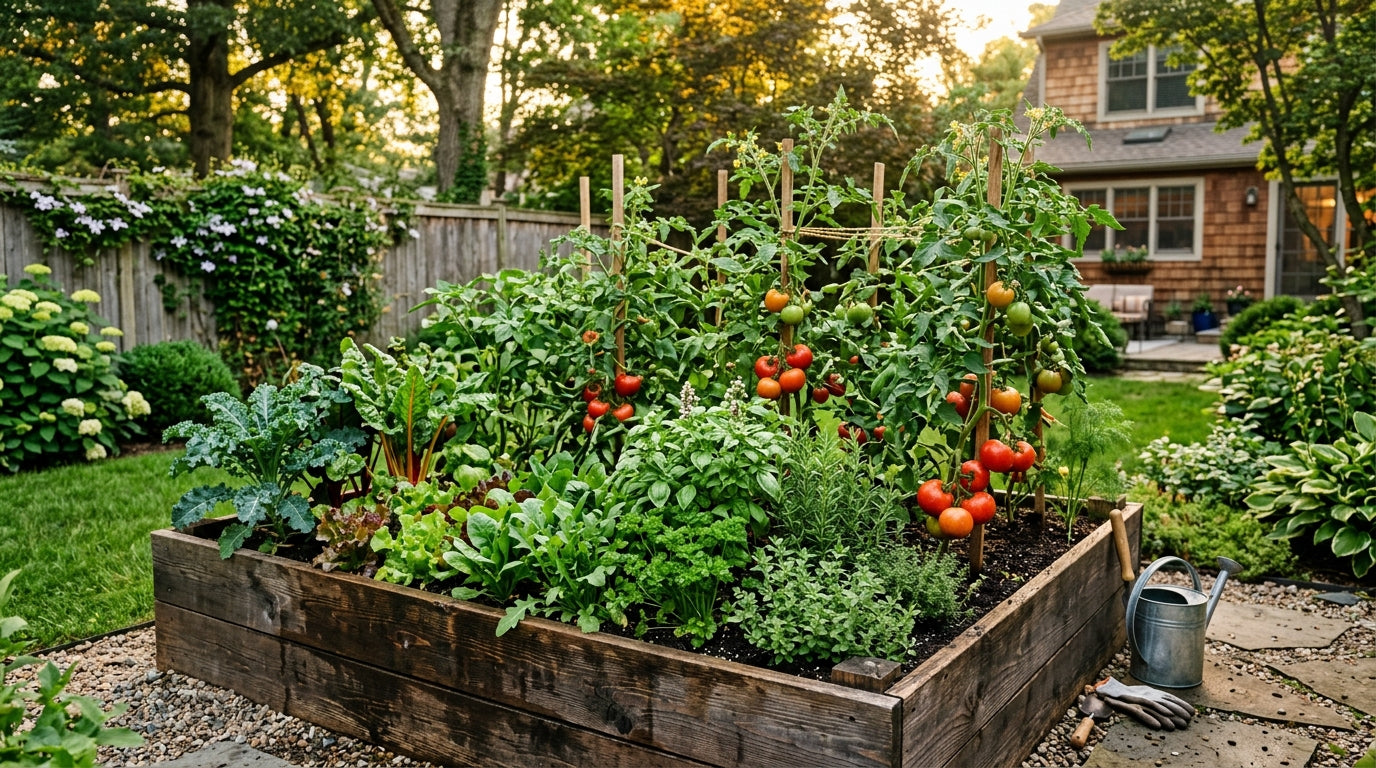
Start with a 4x8 raised bed, or 4–6 containers, or a single 10x10 plot in your yard. Master that before expanding. The compulsion to go big immediately is natural but counterproductive. A small garden you succeed with teaches you infinitely more than a large one that collapses under its own ambition.
Step 2: Understand Your Growing Zone
The USDA Plant Hardiness Zone Map divides the country into growing zones based on average minimum winter temperatures. Your zone determines what you can grow, when you plant, and when your first and last frost dates fall — the two most critical dates in any gardening season.
Look up your zip code on the USDA zone map. Once you know your zone and frost dates, everything else in your planting calendar becomes clear: when to start seeds indoors, when to transplant outside, and how long your growing window actually is.
Step 3: Choose the Right Location
Most food crops need at least 6 hours of direct sunlight per day — ideally 8. Before you dig or build anything, observe your yard through a full day and identify where the sun actually falls and for how long. South-facing exposures generally get the most sun in the Northern Hemisphere.
Other location considerations:
- Water access — you'll water frequently, especially in summer. Don't put your garden 200 feet from the nearest hose
- Wind exposure — heavy wind damages plants and dries soil faster. Some windbreak (a fence, hedgerow, or structure) on the prevailing wind side helps
- Drainage — low spots that collect standing water will drown root systems. Raised beds solve drainage problems elegantly
Step 4: Build Good Soil
Soil is everything. Seeds don't fail — soil fails seeds. Most suburban yard soil is compacted, nutrient-poor, and structurally wrong for vegetable production. You have two options:
Amend In-Ground Soil
Till in 4–6 inches of compost, aged manure, or quality topsoil. This is the slower path but builds lasting soil health. Do it in fall for spring planting so organic matter has time to break down.
Build Raised Beds with New Soil
The fastest path to productive growing. Fill raised beds with a mix of topsoil, compost, and an aerating amendment like perlite or coarse sand. A standard "Mel's Mix" (1/3 compost, 1/3 peat moss or coconut coir, 1/3 coarse vermiculite) is proven and reliable for beginners.
Either way, healthy soil should be dark, loose, and slightly moist — it should hold a clump when squeezed but break apart easily. If it's gray, compacted, or sandy white, it needs work before you plant.
Step 5: Choose Beginner-Friendly Crops
Some vegetables are forgiving of beginner mistakes and produce abundantly with minimal intervention. Start here:
High Success, High Yield
- Zucchini and summer squash — almost impossible to kill; produces so aggressively you'll be handing it to neighbors
- Green beans — fast-growing, minimal care, productive in small spaces
- Radishes — ready to eat in 25–30 days; great for filling gaps between slower crops
- Lettuce and salad greens — cut-and-come-again harvesting; shade-tolerant; can be grown in containers
- Tomatoes — require more attention but are deeply rewarding and highly productive in the right conditions
Perennials Worth Planting Year One
- Herbs — basil, chives, oregano, and thyme grow easily, add tremendous value to your kitchen, and some (chives, thyme) come back every year
- Asparagus — takes 2–3 years to fully produce but then comes back for 20+ years with almost no maintenance
Save These for Year Two
Corn, melons, and brassicas (broccoli, cabbage, Brussels sprouts) are more demanding in terms of space, pest management, and timing. Learn the basics first.
Step 6: Use Heirloom Seeds for Long-Term Resilience
Heirloom seeds are open-pollinated varieties that have been saved and passed down for generations. Unlike hybrid seeds sold at most garden centers, heirloom seeds can be saved from your harvest and replanted year after year — giving you a self-sustaining seed supply that doesn't require annual purchases.
From a preparedness standpoint, this matters enormously. A good heirloom seed collection is a long-term food production asset that renews itself. Seeds stored properly in a cool, dry, dark environment can remain viable for 3–10 years depending on variety.
Look for non-GMO, open-pollinated heirloom varieties — the kind that let you save seed and maintain your own supply indefinitely.
Step 7: Water Consistently
Most vegetables need 1–2 inches of water per week, delivered consistently. Inconsistent watering — drought followed by flood — causes problems: blossom end rot in tomatoes, cracking in root vegetables, bitter flavor in greens. Consistent, deep watering is better than frequent shallow watering because it encourages roots to grow down rather than staying near the surface.
Drip irrigation or soaker hoses are the most water-efficient option and keep foliage dry, which reduces fungal disease. At minimum, water at the base of plants rather than overhead.
Step 8: Think Beyond the Garden
Homesteading expands naturally over time. Once you have a productive garden, the next steps most beginners add are:
- Composting — turns kitchen and yard waste into free soil amendment; closes the loop on food production
- Food preservation — canning, dehydrating, and fermenting extend the harvest through winter; a garden without preservation is seasonal, not self-sufficient
- Fruit trees and bushes — plant them early because they take time; a single established apple tree or blueberry bush produces for decades
- Chickens — eggs, pest control, and compost input; the most common first livestock for suburban homesteaders
- Rain collection — reduces water costs and provides irrigation backup during restrictions or dry periods
Each of these is a module you add when you're ready. You don't need all of them to start. A garden that produces fresh food through summer is a legitimate homesteading foundation.
The Preparedness Connection
A producing homestead is living preparedness — not gear in a closet but skills and systems that generate real outputs. When supply chains tighten, when prices spike, when shortages hit, a household that produces even a portion of its own food is in a fundamentally different position than one that doesn't.
Pair your garden with a solid emergency kit and you've covered both short-term disruption (bug out bag, 72-hour kit) and longer-term resilience (food production, preservation, seed saving). Browse our home preparedness collection for tools that bridge both worlds — from water storage to canning supplies and seed vaults.
Frequently Asked Questions
How much land do I need to homestead?
None specifically. Container gardens on a balcony qualify. A 4x8 raised bed in a suburban backyard qualifies. Meaningful homesteading is about skills and production, not acreage. Scale up as your skills and space allow.
How much does it cost to start a garden?
A basic 4x8 raised bed setup — lumber, soil, seeds, and basic tools — runs $150–300. Seeds are the cheapest part. Quality soil and the bed itself are the main costs. The investment pays back quickly in produce.
What's the easiest vegetable to grow for beginners?
Zucchini wins almost every time. It grows aggressively in almost any climate, tolerates beginner mistakes, and produces prolifically from just a few plants. Green beans and radishes are close seconds.
Can I homestead in an apartment?
To a degree — yes. Container herbs, microgreens, and compact varieties of tomatoes and peppers grow well indoors near a sunny window or under grow lights. Sprouts and fermentation require no outdoor space at all. It's not a full homestead, but it builds skills and produces real food.
What are heirloom seeds and why do preppers prefer them?
Heirloom seeds are open-pollinated varieties you can save and replant indefinitely. Hybrid seeds produce sterile or inferior offspring. For long-term food security, the ability to save seed and replant without purchasing more is a significant advantage — especially in scenarios where supply chains are disrupted.