How to Start Prepping: A No-BS Beginner's Guide for 2026
How to Start Prepping: A No-BS Beginner's Guide for 2026
Most people come to prepping one of two ways: a disaster hits close to home and they realize they weren't ready, or they simply start asking "what would I actually do if the power went out for two weeks?"
Either way, welcome. You're in the right place.
Prepping gets a bad reputation from the extreme end — bunkers, years of food stores, full NBC gear. But the reality of practical preparedness is a lot more grounded than that. It's about reducing your family's vulnerability to the predictable, everyday emergencies that happen all the time: hurricanes, ice storms, wildfires, job loss, supply chain disruptions, and yes — the occasional societal stress test.
This guide is for people starting from zero. No gear collection assumed. No politics. No paranoia. Just a practical framework for getting prepared in a way that actually works for a normal household.
Step 1: Understand What You're Actually Preparing For
The first mistake most beginners make is preparing for Hollywood scenarios — EMP attacks, nuclear war, zombie apocalypses — before they've handled the mundane ones. The most likely emergency you'll face is:
- A 3–7 day power outage (more common every year as grid stress increases)
- A regional natural disaster — wildfire, hurricane, ice storm, tornado, flood
- A financial disruption — job loss, medical bill, economic shock
- A local water supply contamination event
- A civil disruption that makes leaving home temporarily unsafe
Preparing for these scenarios first gives you 80% of the benefit of prepping with 20% of the complexity. Handle the common before the catastrophic.
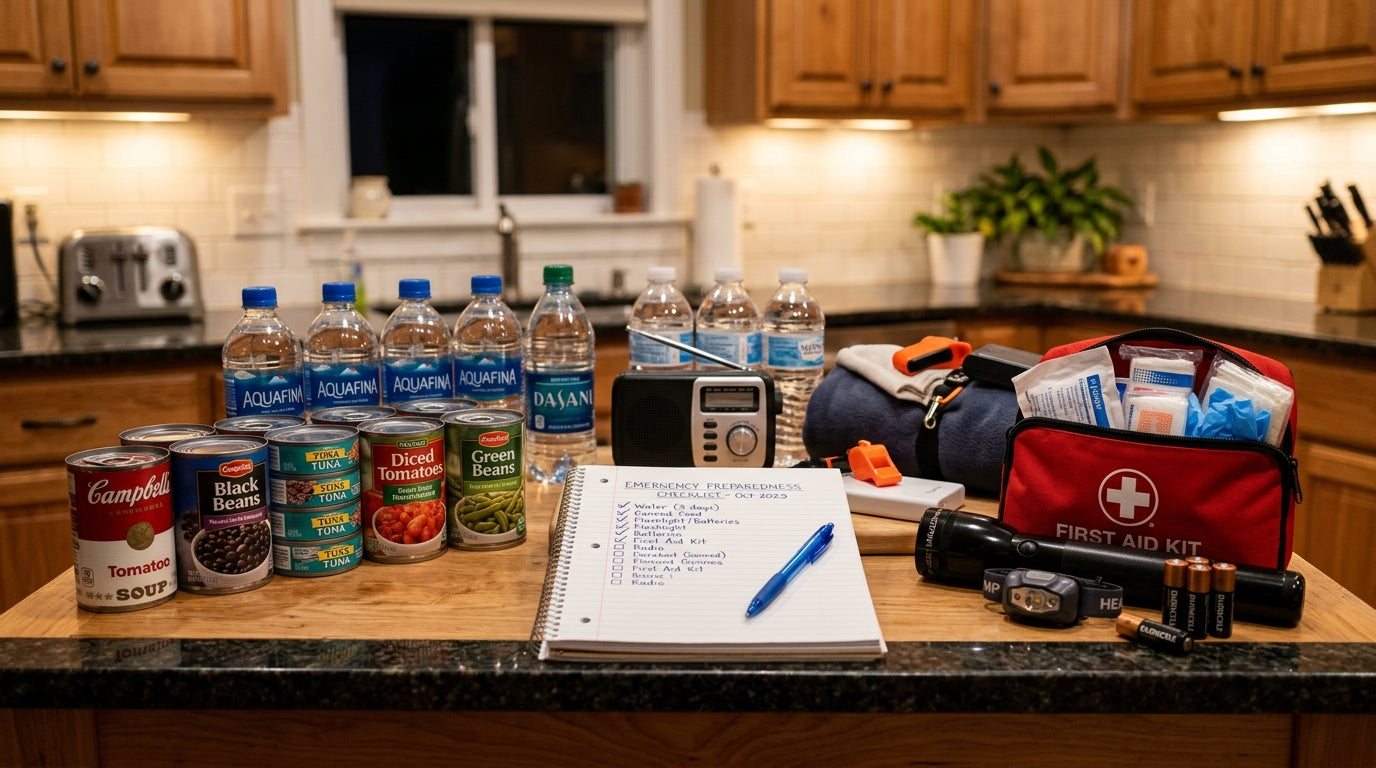
Step 2: Build Your 72-Hour Emergency Foundation
FEMA, the Red Cross, and virtually every emergency management organization in the country agrees on this starting point: every household should be able to sustain itself for at least 72 hours without external help.
That means three days of food, water, and basic supplies for every person in your household. This is your foundation. Everything else builds on top of it.
Water First
Store one gallon of water per person per day, minimum. For a family of four, that's 12 gallons for 72 hours. Store it in food-grade containers, away from direct sunlight, and rotate it every 6–12 months. Also invest in a portable water filter — this turns any water source into a safe one.
Food Second
You don't need freeze-dried mountain meals (though they're great). Start with shelf-stable versions of what your family already eats — canned goods, dry grains, peanut butter, crackers. Three days worth per person, plus a manual can opener. Rotate stock as you use it.
Bug Out Bag Third
Your 72-hour kit in a backpack, ready to go if you have to leave your home fast. This is different from your home food/water stores — it goes with you. If you want to skip building one from scratch, our fully loaded 72-hour bug out bag covers all the essentials in one package.
Step 3: Know Your Risks Before You Spend a Dollar on Gear
Prepping without a threat assessment is just hoarding. Spend 30 minutes on this before you buy anything else.
Ask yourself:
- What natural disasters are most likely in my region? (FEMA's website has risk maps by county.)
- How far do I live from work? Could I walk home if I had to?
- Does my household have specific medical needs — medications, equipment, dietary restrictions?
- Do I have children, elderly family members, or pets with special requirements?
- What's my most realistic "bug in" scenario vs. "bug out" scenario?
The answers to these questions determine what you prioritize. Someone in Phoenix with a fixed-income senior parent has a different prep list than a 30-year-old in a wildfire zone with two kids and a truck.
Step 4: Build Your Home Prep Layer
Once your 72-hour baseline is covered, expand to home-based preparedness. This is your "shelter in place" capability — assuming you stay home and need to sustain yourself for 1–4 weeks without resupply.
Extended Food Storage
Expand from 3 days to 2 weeks to 30 days. This doesn't require a dedicated pantry or freeze-dried meals (though both help). It means intentionally deepening your existing pantry with items that store well and that your family will actually eat.
Power & Communication
- A hand-crank or battery weather radio — your lifeline when the internet and cell towers are down
- Backup lighting — rechargeable lanterns, headlamps, candles
- A battery bank for phones
- A generator or portable solar panel for extended outages (longer-term investment)
Security & Access
Know where your utility shutoffs are. Have basic tools to use them. A gas shutoff wrench belongs in every household. Browse our home prep gear for items that fit this category.
Step 5: Build an Emergency Plan — Not Just a Gear List
Gear without a plan is just expensive clutter. Your emergency plan should answer these questions before an emergency makes them urgent:
- Where do we go if we have to leave? Identify a primary and backup bug-out destination — a family member's home, a hotel outside your risk zone, a campground. Drive the routes.
- How do we communicate if cell service is down? Designate an out-of-state contact as a relay point. Everyone in the family knows the number by heart.
- What are our evacuation triggers? Don't wait for a mandatory order. Decide in advance: "If X happens, we leave." Removes emotion from a high-stress decision.
- Where are our documents? Keep copies of IDs, insurance cards, emergency contacts, prescriptions, and financial info in a waterproof bag in your bug out bag.
- Who is responsible for what? In a two-adult household, split the grab-and-go tasks. One person gets the kids. One person grabs the bags. No confusion, no delay.
Step 6: Practice, Don't Just Prepare
Here's where most preppers fail. They build the kit and put it in the closet. Then five years later, half the food is expired, the batteries are dead, and they've never actually worn the bag for more than two minutes.
Practice your plan at least twice a year:
- Do a "bug out drill" — actually grab the bag, load the car, drive the route to your destination. What takes 20 minutes when calm takes 45 under stress.
- Do a 24-hour "grid down" simulation. Turn off the breaker, don't use your phone, cook only from your emergency stores. You'll find the gaps fast.
- Audit your supplies every 6 months — rotate food, replace expired meds, check batteries.
What You Don't Need to Worry About (Yet)
If you're just starting out, ignore all of this until your basics are covered:
- Bunkers and underground shelters
- Year-long food supplies
- Full NBC (nuclear, biological, chemical) protective gear
- Ham radio licensing
- Off-grid power systems
These are advanced topics with real value, but they're irrelevant if you don't have two weeks of food and a working bug out bag. Crawl before you sprint.
A Word on Why We Do This
At Tactically Prepped, we're not doom merchants. We're regular people who prep because it's the responsible thing to do for our families. The same reason you have car insurance and a smoke detector — not because disaster is inevitable, but because being unprepared when it arrives is a choice you can avoid making.
Preparedness is an act of optimism, not fear. It says: "Whatever comes, we'll handle it."
Your Next Step
If you've read this far, you're already thinking about this more seriously than most of your neighbors. Turn that into action today:
- Take inventory — what do you already have? What's missing?
- Start with water storage this week
- Get a bug out bag in place — build it yourself or grab one of ours
- Write down your evacuation triggers and your rally point
Four steps. You can do them all in a weekend. Browse our full survival gear collection when you're ready to equip yourself properly.
Frequently Asked Questions
How much does it cost to start prepping?
You can build a solid 72-hour foundation for under $300, including a quality bug out bag. Water storage for a family of four costs roughly $50. Start with basics and add over time — prepping doesn't have to happen all at once.
Is prepping the same as survivalism?
They overlap but aren't the same. Survivalism often focuses on extreme long-term scenarios and wilderness self-reliance. Practical prepping focuses on the realistic emergencies most households will actually face — power outages, natural disasters, short-term supply disruptions.
Do I need weapons to be a prepper?
No. Home defense is a personal decision that intersects with preparedness, but it's not a prerequisite. Most beginner preppers focus on food, water, shelter, and first aid before ever addressing security.
How do I get my family on board?
Frame it around things they already understand — what would we do in a power outage? What if we had to leave for a week? Most people are more receptive to "disaster readiness" than "prepping." Start with a conversation about a real local risk (wildfire, hurricane, ice storm) and work from there.